
High-Speed Cameras and High-Speed Recording Software: Part 1
Fluid Flow, Jetting, and Droplet Motion Research
High-Speed Cameras and High-Speed Recording Software: Part 1
Discover how high-speed cameras and recording software capture fluid flow, liquid jets, and droplet motion. Learn about frame rate, exposure, lighting, synchronization, and industrial camera selection.
1. Why Are High-Speed Cameras Needed for Fluid, Jetting, and Droplet Research?
In fluid dynamics, inkjet printing, spray systems, microfluidics, liquid dispensing, and precision jetting, many important events occur over extremely short time intervals.
A droplet may detach from a nozzle, a liquid column may break up, or an impacting droplet may splash within microseconds or milliseconds. A conventional video camera may record the overall process but miss critical transitions because its frame rate is too low to capture the sequence with sufficient temporal resolution.
High-speed cameras address this challenge by acquiring a large number of images over a short period. Combined with high-speed recording software, they allow researchers to examine jet formation frame by frame, track droplet positions, compare experimental conditions, and investigate how flow behavior changes over time.
High-speed imaging offers three major benefits for fluid research:
- Capturing transient events: Recording droplet formation, jet breakup, collisions, and splashing.
- Quantifying motion: Estimating droplet velocity, displacement, size, and trajectory from image sequences.
- Comparing experimental conditions: Evaluating the effects of nozzle geometry, drive parameters, liquid properties, and environmental conditions.
For example, researchers studying high-speed liquid jets have used high-speed videography at frame rates of up to approximately 311,111 fps to capture the initial dynamics of jets emerging from narrow orifices. This demonstrates why some fluid phenomena require much higher acquisition rates than typical industrial inspection. The appropriate frame rate depends on the event and the required temporal resolution—not simply on maximizing FPS.
2. Four Major Applications of High-Speed Imaging in Fluid Research
2.1 Droplet Formation and Detachment
Droplet formation is an important research topic in liquid dispensing, inkjet printing, reagent dispensing, and precise micro-volume control.
After liquid exits a nozzle, it may pass through several stages, including liquid-column extension, necking, breakup, and droplet detachment. Viscosity, surface tension, nozzle diameter, drive pressure, and the actuation waveform can all influence the resulting droplets.
High-speed imaging can help researchers observe:
- Shape changes before a droplet detaches from the nozzle.
- The onset of necking and liquid-column breakup.
- Whether satellite droplets form alongside the main droplet.
- Droplet trajectory, flight distance, and shape changes.
- Consistency across different actuation settings.
Application example: Inkjet droplet research. In inkjet printing, droplet volume, velocity, and flight stability influence printing quality. Satellite droplets or deviations in the flight path can reduce placement accuracy and affect the resulting pattern.
High-speed recording software can display the sequence frame by frame, making it easier to compare changes before and after ejection. Combined with image-analysis algorithms, the recorded sequence can also be used to estimate droplet diameter, centroid position, and flight velocity.
Research has used high-speed imaging to analyze the shape oscillation of airborne droplets and to investigate liquid surface tension and viscosity through image-based measurements.
2.2 Liquid Jetting and Jet Breakup
Liquid jetting occurs in industrial nozzles, fuel injection, liquid dispensing, cleaning equipment, spray systems, and needle-free injection research.
After leaving a nozzle, a liquid column may be influenced by inertia, viscosity, surface tension, air resistance, and jet velocity. These factors can contribute to surface disturbances, necking, breakup, and droplet formation.
High-speed imaging helps researchers investigate:
- The initial shape of a jet as it exits the nozzle.
- The position and velocity of the jet front.
- The formation and propagation of surface waves.
- The location and timing of jet breakup.
- Instabilities and periodic changes during jetting.
These observations can support comparisons between nozzle designs and operating parameters, as well as studies of jet stability and liquid delivery efficiency.
Application example: Testing a high-speed jetting system. Researchers may need to determine how long it takes for a stable jet to form after actuation, where the liquid column begins to break up, and whether changes in drive pressure affect the jet profile.
A trigger signal can coordinate the jetting device with camera acquisition. High-speed recording software then stores a sequence around the trigger event, allowing the jet front, breakup location, and relevant timestamps to be identified frame by frame.
However, when the target phenomenon occurs on a microsecond timescale, a conventional industrial camera operating at around a thousand frames per second may not provide sufficient temporal resolution. Camera selection should reflect the jet velocity, field of view, and specific phenomenon being investigated.
2.3 Droplet Impact, Spreading, and Splashing
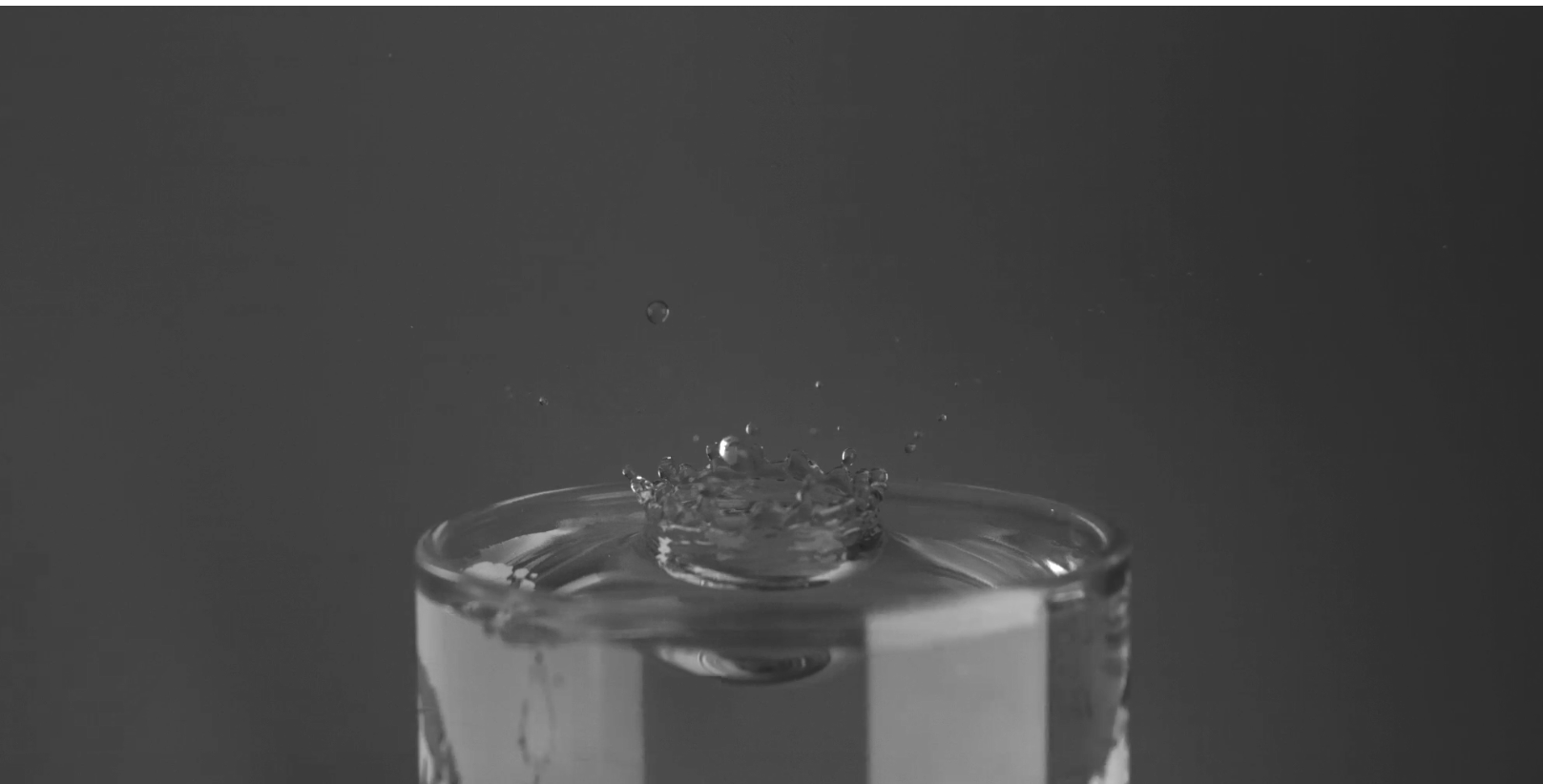
When a droplet impacts a solid surface or another droplet, it may flatten, spread, retract, rebound, merge, or splash.
These processes are relevant to spraying, coating, cooling, cleaning, liquid deposition, and surface treatment.
High-speed cameras capture continuous images before and after impact, allowing researchers to analyze:
- The initial contact between a droplet and a surface.
- Changes in spreading diameter over time.
- Retraction or rebound behavior.
- The number and direction of secondary droplets.
- Differences in wetting and spreading on different surfaces.
Application example: Droplet spreading on different materials. Suppose researchers want to compare how a droplet spreads across several coated surfaces. The experiment can keep droplet volume, release height, and environmental conditions consistent while recording each impact using a high-speed camera.
Image analysis can then measure the droplet boundary and maximum spreading diameter. Comparing the resulting curves provides repeatable image-based evidence rather than relying only on static photographs taken after impact.
For studies involving contact angle, interface shape, or very small splashes, the lens resolution, illumination, and image contrast must also meet the measurement requirements.
2.4 Spray, Atomization, and Multi-Droplet Motion
Spraying and atomization generate droplets of different sizes and velocities. These processes occur in coating, combustion research, agricultural spraying, humidification, cooling, and liquid atomization equipment.
High-speed imaging can reveal spray-cone geometry, droplet trajectories, spray boundaries, and changes in droplet dispersion or clustering.
However, conventional high-speed video is generally better suited to observing resolvable droplets and overall spray behavior. Measuring very small droplet-size distributions or three-dimensional velocity fields in dense sprays may require additional methods, such as laser-sheet illumination, microscopy, particle image velocimetry (PIV), or other specialized measurement techniques.
Camera selection should therefore begin with a clear research objective: observing spray morphology, tracking individual droplets, or quantitatively measuring size and velocity distributions.
3. How Do High-Speed Cameras and Recording Software Work Together?
The camera acquires images, while the recording software configures acquisition, records image sequences, and provides data for subsequent analysis.
A typical experimental system includes:
- High-speed camera: Selected according to target velocity and required spatial resolution.
- Lens: Determines field of view, working distance, and spatial resolution.
- Illumination: Provides sufficient brightness and image contrast.
- Triggering equipment: Coordinates camera acquisition with a jetting device, valve, or other experimental equipment when needed.
- Recording software or acquisition application: Configures acquisition, displays live images, and saves video or image sequences.
- Image-analysis tools: Support contour extraction, position tracking, velocity estimation, and dimensional measurement.
Key Features of High-Speed Recording Software
For fluid and droplet research, software should do more than display images. Researchers should consider the following functions:
| Feature | Role in the experiment |
|---|---|
| Frame-rate and exposure controls | Manage temporal sampling and motion blur |
| Continuous acquisition and sequence recording | Capture the full process of droplet formation, jetting, and impact |
| Hardware triggering and acquisition control | Coordinate the timing of the camera and experimental equipment |
| Live image preview | Adjust focus, field of view, illumination, and exposure |
| Image or video export | Provide data for subsequent analysis |
| SDK and development interfaces | Integrate image acquisition into customized experimental systems |
Available features vary by camera model, interface, driver, and software version. Before conducting an experiment, verify camera compatibility and confirm trigger support, buffering behavior, image formats, and file-saving options.
4. How to Choose the Right Frame Rate and Exposure Time
Frame rate and exposure time are two of the most important parameters in high-speed imaging, but they serve different purposes.
- Frame rate (FPS): Determines how many images are acquired per second and affects temporal sampling.
- Exposure time: Determines the integration time for each frame and directly affects motion blur and illumination requirements.
4.1 Estimate Frame Rate from Target Velocity
If a droplet travels at velocity v, and the desired displacement between consecutive frames is no more than d, a preliminary minimum frame rate can be estimated using:
f ≥ v / d
Where:
- f is the frame rate in frames per second.
- v is the target velocity in units of distance per second.
- d is the maximum desired displacement between consecutive frames, expressed in the same distance unit.
Example: If a droplet travels at approximately 5 m/s and the desired displacement between frames is no more than 0.5 mm:
f ≥ 5 / 0.0005 = 10,000 fps
This gives an initial sampling target of 10,000 fps. It is only a simplified estimate based on inter-frame displacement and does not guarantee that faster local events, such as jet breakup, will be resolved. The final frame rate should also reflect the event duration, research objective, and required temporal resolution.
4.2 Estimate Exposure Time from Motion Blur
For a target moving at velocity v, if the acceptable motion blur is no more than b, the exposure time can be estimated as:
t ≤ b / v
For example, if a droplet travels at 5 m/s and the acceptable blur distance is 0.05 mm:
t ≤ 0.00005 / 5 = 10 μs
An exposure time of 10 μs or shorter can serve as an initial test point. The achievable exposure time depends on illumination intensity, lens aperture, sensor sensitivity, and image signal-to-noise ratio.
Important: Increasing frame rate does not replace shortening exposure time. Even at thousands of frames per second, a long exposure can produce visibly blurred droplet boundaries.
5. Illumination and Imaging Setup for Fluid Experiments
Illumination is often just as important as camera settings in droplet and jetting research.
Backlighting
Placing a light source behind the droplet or liquid column produces a silhouette that is often suitable for:
- Droplet diameter and contour measurement.
- Liquid-column width and breakup analysis.
- Spray-boundary observation.
- Recording droplet impact and spreading.
Backlighting can improve the visibility of transparent liquid boundaries, but overexposure and uneven illumination should be avoided.
Diffuse and Side Illumination
When the experiment requires visible internal structures, surface reflections, or additional spray details, diffuse lighting, side illumination, or other optical arrangements may be appropriate. Refraction and reflection from transparent liquids can produce bright highlights, so preliminary tests should be used to optimize light position and angle.
Microscopy and Small Droplets
Microscope objectives or high-magnification lenses may be needed to observe micron-scale droplets or fine details near a micro-nozzle outlet. Higher magnification reduces the field of view and may reduce depth of field. Engineers should also verify:
- Whether the entire target region remains within the field of view.
- The physical size represented by each pixel.
- Whether focus covers the relevant droplet-motion range.
- Whether sufficient illumination is available at high magnification.
6. MindVision High-Speed / High-Frame-Rate Industrial Cameras and Recording Software
For fluid, jetting, and droplet-motion research, MindVision industrial cameras can be evaluated as potential components of an experimental imaging system. The appropriate model depends on target velocity, field of view, exposure time, spatial resolution, and data bandwidth.
In addition to the MV-H2F205GM dual-fiber camera discussed earlier, the MV-PX250GC/GM, MV-PX1000GC/GM, and MV-XGC51GC/GM can also be considered according to the experimental objective. In these model names, "GC" generally denotes color and "GM" monochrome; refer to the latest datasheet for the specific model.
6.1 Selection Guide for Fluid Research
| Model | Main imaging characteristics | Possible role in fluid/jetting/droplet research | Selection notes |
|---|---|---|---|
| MV-H2F205GM | 2048 × 1080; rated up to approx. 1068.25 FPS at full resolution; global shutter; dual 16G fiber links, 32 Gbps combined; ROI support | Kilo-frame-level observation of jetting changes, droplet motion, liquid-column contours, and impact/spreading | Suitable when temporal changes are relatively slow and can be sampled at around a thousand frames per second; not a substitute for microsecond-scale specialized high-speed imaging |
| MV-PX250GC/GM | 2.5 MP, 2048 × 1216 MAX@1876.5 FPS; 4.5 μm pixel; 2/3" sensor; global shutter; CXP12-4 (HD-BNC); exposure 0.0010–65.5350 ms | Droplet formation, jet breakup, jet-front tracking, and impact/spreading where higher temporal sampling plus contour information is needed | High frame rate and resolution require evaluation of CXP-12 frame grabber, bandwidth, storage, and illumination; actual frame rate depends on exposure, ROI, interface, and recording method |
| MV-PX1000GC/GM | 10 MP, 4608 × 2176 MAX@463.75 FPS; 4.5 μm pixel; global shutter; CXP12; M58×0.75 lens mount; exposure 0.0010–65.5350 ms | Large-field, high-spatial-resolution observation of spray morphology, multi-droplet motion, spreading contours, and surface details when temporal changes are relatively slower | Full-resolution frame rate is below the kilo-frame level; for microsecond breakup or very fast jet fronts, evaluate ROI frame-rate improvement or a higher-frame-rate camera |
| MV-XGC51GC/GM | 0.5 MP, 816 × 624@1609.25 FPS; 1/1.7" CMOS (IMX426); 9.0 μm pixel; 10 GigE; C-mount; exposure 0.0008–838.86 ms; 1 GB frame buffer; GigE Vision/GenICam | Small-field, kilo-frame-level screening of resolvable droplets/jetting where spatial resolution requirements are moderate; longer cable runs and lower system cost | Lower pixel count limits fine contour measurement; datasheet indicates frame exposure, so it should not be described as a global-shutter camera; verify recording software, 10GigE NIC, cabling, and sustained write performance |
6.2 Product Examples and Application Notes
(1) MV-H2F205GM: kilo-frame-level dual-fiber industrial camera
According to MindVision's product information, the MV-H2F205GM offers 2048 × 1080 resolution, a rated full-resolution frame rate of up to approximately 1068.25 FPS, a global shutter, dual 16G fiber links with 32 Gbps combined bandwidth, and ROI support. For experiments involving relatively slower changes in jetting conditions or droplet motion that can be resolved at around a thousand frames per second, this type of high-speed industrial camera may be worth evaluating. A global shutter can also help reduce geometric distortion caused by motion during image acquisition.
However, 1068 FPS is not sufficient for every high-speed fluid experiment. Microsecond-scale jet breakup, very fast jet fronts, and rapid changes in tiny droplets may require specialized cameras with much higher frame rates. Before selection, verify the resolution available at the target frame rate, exposure-time range, actual output performance, and software compatibility.
(2) MV-PX250GC/GM: 2.5 MP CXP-12 camera at up to approximately 1876.5 FPS
According to the MV-PX250GC/GM product information, this model uses a CXP-12 interface and provides 2048 × 1216 resolution, a rated full-resolution frame rate of up to approximately 1876.5 FPS, 4.5 μm pixels, a 2/3" optical format, a global shutter, CXP12-4 (HD-BNC) data interface, and an exposure range of 0.0010–65.5350 ms. It also supports ROI, triggering, and various image-processing functions.
For droplet formation and detachment, liquid-column necking and breakup, jet-front localization, and droplet impact/spreading, the MV-PX250GC/GM is relevant because it combines 2.5 MP-level contour information with higher temporal sampling than a roughly 1000 FPS camera. For example, when a droplet travels at about 5 m/s and the desired inter-frame displacement is no more than 0.5 mm, the simplified estimate in Section 4 gives a minimum sampling rate of about 10,000 FPS. In that case, 1876.5 FPS may still not resolve every fast local event, but it can be evaluated as a higher-frame-rate industrial camera option. If the phenomenon is slower, or if ROI reduces the observation region, the actual frame rate, exposure, and bandwidth should be confirmed through testing.
Importantly, 1876.5 FPS is the rated maximum full-resolution frame rate in the product information; it does not mean that every experiment can record at that frame rate and resolution for a long duration. The CXP-12 frame grabber, host bandwidth, disk write speed, exposure time, and illumination intensity all affect the usable frame rate. For microsecond-scale jet breakup or very small droplets, higher-frame-rate specialized cameras or microscopic high-speed imaging should still be evaluated.
(3) MV-PX1000GC/GM: 10 MP CXP-12 camera at up to approximately 463.75 FPS
The MV-PX1000GC/GM product information lists 10 MP resolution, 4608 × 2176 at a rated full-resolution frame rate of up to approximately 463.75 FPS, 4.5 μm pixels, a global shutter, a CXP12 interface, an M58×0.75 lens mount, and an exposure range of 0.0010–65.5350 ms. This model is better suited to fluid experiments where spatial resolution is the priority and temporal changes are relatively slower, such as large-field spray-cone and boundary observation, multi-droplet motion, droplet spreading contours on material surfaces, and coating or deposition morphology.
If the research target is microsecond-scale jet breakup, a very fast jet front, or rapid deformation of tiny droplets, 463.75 FPS at full resolution is generally insufficient for temporal sampling. A high pixel count alone does not make a camera suitable for all high-speed fluid research. Such experiments should first evaluate higher-frame-rate models, or test the actual frame rate, exposure, and field-of-view coverage achievable with reduced resolution/ROI. High-resolution images also substantially increase data volume, so storage, interface bandwidth, and image-analysis workflow should be estimated before the experiment.
(4) MV-XGC51GC/GM: 0.5 MP 10GigE camera at up to approximately 1609.25 FPS
The MV-XGC51GC/GM product information lists 0.5 MP resolution, 816 × 624@1609.25 FPS, a 1/1.7" CMOS sensor (IMX426), 9.0 μm pixels, a 10 GigE interface, a C-mount, an exposure range of 0.0008–838.86 ms, a 1 GB frame buffer, and support for GigE Vision and GenICam, together with trigger- and synchronization-related I/O. Its 10GigE interface can support longer cable runs with suitable cabling, which can be useful when industrial wiring constrains the experimental setup.
In fluid research, the MV-XGC51GC/GM is better suited to small-field, kilo-frame-level screening where spatial resolution requirements are moderate, such as observing the motion direction of resolvable droplets, the initial jetting stage, droplet-detachment timing, or spray-boundary changes. Its lower pixel count is not suitable for fine droplet-contour or tiny-splash size measurement; for micron-scale droplets or high-accuracy contact-angle/spreading-diameter measurement, higher-resolution configurations with microscope optics should be considered. The datasheet indicates frame exposure for this model, so it should not be described as a global-shutter camera.
6.3 Four Typical Selection Examples
The following examples are "assumed experimental conditions + simplified estimates" to illustrate how velocity, exposure, field of view, and resolution translate into camera selection. They are not performance guarantees.
Example 1: Inkjet droplet formation and satellite-droplet observation
Assume droplet velocity ≈ 1 m/s, main droplet diameter ≈ 0.2 mm, field of view ≈ 3 mm × 2 mm, desired inter-frame displacement ≤ 0.5 mm, and acceptable motion blur ≤ 0.05 mm.
Frame-rate estimate: f ≥ 1 / 0.0005 = 2000 fps.
Exposure estimate: t ≤ 0.00005 / 1 = 50 μs.
The MV-PX250GC/GM can be evaluated first: its full-resolution maximum is about 1876.5 FPS, slightly below 2000 fps, but ROI can increase the frame rate. With 4.5 μm pixels, a 0.2 mm droplet covers about 44 pixels, sufficient for contour and satellite-droplet observation; the exposure range covers 50 μs. The MV-XGC51GC/GM reaches 1609.25 FPS, close to but below 2000 fps; at 9 μm per pixel, the droplet covers about 22 pixels, making it more suitable for small-field screening. The MV-PX1000GC/GM at 463.75 FPS is insufficient for 2000 fps-level temporal sampling and is better suited to slower processes or large-field, spatial-resolution-priority work.
Example 2: High-speed liquid-column breakup and jet-front observation
Assume jet velocity ≈ 5 m/s, desired inter-frame displacement ≤ 0.5 mm, liquid-column diameter ≈ 0.5 mm, observation region ≈ 5 mm × 3 mm, and acceptable blur 0.05 mm.
Frame-rate estimate: f ≥ 5 / 0.0005 = 10,000 fps.
Exposure estimate: t ≤ 0.00005 / 5 = 10 μs.
This example shows that "the highest FPS is not necessarily enough." At 1876.5 fps full resolution, a 5 m/s target moves about 2.7 mm per frame for the MV-PX250GC/GM, exceeding 0.5 mm; even with ROI, whether 10,000 fps can be approached must be tested. The MV-XGC51GC/GM and MV-PX1000GC/GM provide lower temporal sampling. All three cameras are better suited to slower surface waves, breakup-location trends, or overall jet morphology; microsecond breakup should be evaluated with a higher-frame-rate specialized camera, or by accepting larger inter-frame displacement and reducing the observation region.
Example 3: Droplet impact, spreading, and retraction
Assume droplet diameter ≈ 2 mm, impact velocity ≈ 0.5 m/s, spreading/retraction characteristic time ≈ 10 ms, at least one frame per 1 ms (≈1000 fps), maximum spreading diameter ≈ 4 mm, and acceptable blur 0.05 mm.
Frame-rate estimate: ≈1000 fps.
Exposure estimate: t ≤ 0.00005 / 0.5 = 100 μs.
The MV-PX250GC/GM at 1876.5 fps exceeds 1000 fps; with 2048 pixels across and 4.5 μm pixels, a 2 mm droplet covers about 444 pixels and a 4 mm spreading diameter about 889 pixels, providing ample contour margin. The global shutter helps reduce motion distortion, making it a strong option for spreading diameter, retraction, and contact-angle contour measurement. The MV-XGC51GC/GM can record at kilo-frame level, but at 9 μm per pixel contour detail is lower, and its frame exposure requires caution at fast spreading edges. The MV-PX1000GC/GM at 463.75 fps full resolution is below 1000 fps and is better suited to longer spreading times or large-field multi-droplet recording.
Example 4: Spray-cone angle and multi-droplet overall motion
Assume field of view ≈ 30 mm × 20 mm, resolvable droplet ≈ 0.3 mm, at least 10 pixels per droplet (spatial resolution better than about 30 μm/pixel), and hundreds-to-kilo-frame-level recording.
MV-PX1000GC/GM: 4608 pixels across gives about 6.5 μm/pixel over 30 mm; a 0.3 mm droplet covers about 46 pixels. Spatial resolution is sufficient, but full-resolution 463.75 fps suits slower spray-cone evolution and overall morphology.
MV-PX250GC/GM: 2048 pixels across gives about 14.6 μm/pixel over 30 mm; a 0.3 mm droplet covers about 20 pixels. It resolves overall and larger droplets, and 1876.5 fps provides higher temporal sampling than the PX1000 for faster overall changes.
MV-XGC51GC/GM: 816 pixels across gives about 36.8 μm/pixel over 30 mm; a 0.3 mm droplet covers only about 8 pixels, which is low. It is better for small-field kilo-frame screening than for 30 mm large-field droplet sizing.
MV-H2F205GM: 2048 pixels across gives about 14.6 μm/pixel; 1068.25 fps makes it a medium-field overall spray-recording option.
Therefore, large-field and spatial-resolution priority favors the MV-PX1000GC/GM; medium-field with higher temporal sampling favors the MV-PX250GC/GM; small-field kilo-frame screening favors the MV-XGC51GC/GM.
6.4 High-Speed Recording Software, SDK, and System Integration
The camera acquires images, while the recording software configures acquisition, records image sequences, and provides data for subsequent analysis. MindVision's official software download center provides high-speed recording software, camera platform software, and SDK resources that can serve as a starting point for image acquisition and experimental recording.
For CXP-12 cameras such as the MV-PX250GC/GM and MV-PX1000GC/GM, confirm compatibility among the frame grabber, CXP cables, host PCIe bandwidth, recording software, and SDK. The product information notes that the SDK is designed to reduce the need for users to operate the CXP frame grabber directly, but actual integration should still follow the documentation for the specific SDK version and frame grabber. For the MV-XGC51GC/GM, confirm the 10GigE network interface card, CAT 6A/10GBase-T cabling, use of the 1 GB frame buffer, trigger mode, and sustained write capability. For the MV-H2F205GM, verify the dual-fiber interface, ROI, triggering, and long-duration acquisition configuration.
For any model, before the experiment confirm the available resolution at the target frame rate, exposure-time range, trigger latency, buffer behavior, image/video formats, continuous-recording duration, and whether the recording software supports the selected camera model. If the experiment requires automated control of a jetting device, synchronization across multiple devices, or real-time droplet tracking, the integration options provided by the SDK and a customized acquisition application should also be evaluated.
MindVision can help assess industrial camera options and integration approaches based on specific imaging requirements. When discussing a project, provide the expected jet velocity, droplet size, field of view, target frame rate, illumination conditions, triggering method, and expected recording duration to support a more accurate evaluation.
7. Frequently Asked Questions
Start with the target velocity v and the allowable inter-frame displacement d: f ≥ v / d. For example, at 5 m/s with a desired displacement of no more than 0.5 mm, the minimum sampling target is about 5 / 0.0005 = 10,000 fps. This estimate addresses inter-frame displacement only; it does not guarantee resolving faster local events such as jet breakup or satellite-droplet separation. The final frame rate should also reflect event duration, required temporal resolution, exposure conditions, and test results.
For target velocity v and acceptable blur b: t ≤ b / v. For example, at 5 m/s with 0.05 mm acceptable blur, exposure should be about 10 μs or shorter. Achievable exposure also depends on illumination intensity, lens aperture, sensor sensitivity, and signal-to-noise ratio. Increasing frame rate does not replace shortening exposure; long exposure can still blur droplet edges at a high frame rate.
No. A higher frame rate increases temporal sampling, but sharpness also depends on exposure time, illumination, lens resolution, focus, and sensor performance. Long exposure causes motion blur, while insufficient illumination forces a trade-off with noise. Sharp high-speed images generally require an appropriate frame rate, sufficiently short exposure, adequate illumination, and suitable lens/focus settings.
Yes, but suitability depends on the experimental requirements. Begin with target velocity, droplet or jet size, field of view, allowable blur, required frame rate, exposure range, triggering method, and recording duration. Then verify the actual resolution at the target frame rate, interface bandwidth, and software compatibility. Models such as the MV-H2F205GM, MV-PX250GC/GM, MV-PX1000GC/GM, and MV-XGC51GC/GM can be evaluated against these conditions. Microsecond breakup, micron-scale droplets, or high-accuracy quantitative studies may still require specialized high-speed cameras, microscope optics, or PIV, with actual temporal and spatial resolution verified through testing.
That depends on whether the software provides the necessary measurement functions. If it is mainly used for acquisition and recording, image sequences can be exported for pixel calibration, droplet segmentation, contour extraction, and position tracking to estimate velocity, diameter, and trajectory. If built-in measurement modules are available, verify their calibration method, tracking algorithm, occlusion handling, and measurement accuracy. For transparent droplets, satellite droplets, and high-speed splashing, retain the original image sequences for review.
High-speed acquisition generates large data volumes in a short time. File size depends mainly on resolution, bit depth, frame rate, recording duration, and compression. Before the experiment, estimate the per-frame data size, data rate at the target frame rate, expected recording duration, and buffering requirements, and confirm that interface bandwidth, host memory, and sustained disk write speed are sufficient. Otherwise, achievable recording duration or usable frame rate may be lower than the camera's rated specification. For CXP-12 and 10GigE cameras, also verify the frame grabber, PCIe bandwidth, network interface card, cabling, and recording-software configuration.
Common methods include hardware triggering, external synchronization signals, and software control. For precise timing after jet initiation, verify trigger latency, exposure timing, acquisition-buffer behavior, and pre-trigger settings, and perform a synchronization test before the main experiment. Record a sequence before and after the trigger, and check the actual timing relationship using timestamps and frame order. For microsecond-scale events, also confirm trigger jitter and exposure start/end timing.
First estimate the object-space pixel size: object-space pixel size ≈ field-of-view width ÷ horizontal pixel count. Droplet pixel coverage ≈ droplet size ÷ object-space pixel size. If only motion direction is required, fewer pixels per droplet may be acceptable; for contour, diameter, or contact-angle measurement, higher pixel coverage is generally needed. For example, with a 30 mm field of view and 2048 pixels horizontally, the object-space pixel size is about 14.6 μm, and a 0.3 mm droplet covers about 20 pixels. With 816 pixels horizontally, the object-space pixel size is about 36.8 μm/pixel, and the same droplet covers only about 8 pixels, which is low for dimensional measurement. ROI can reduce the readout area and increase frame rate, but it narrows the field of view and is constrained by exposure, bandwidth, storage, and software support. Before using ROI, confirm that the target remains inside the region and measure the actual frame rate and calibration relationship.
Conclusion
High-speed cameras and recording software provide important tools for observing transient phenomena in fluid, jetting, and droplet-motion research. From droplet detachment and liquid-column breakup to droplet impact and spray analysis, reliable results depend not only on frame rate but also on exposure time, illumination, lens selection, trigger synchronization, and the subsequent image-analysis workflow.
The key to selection is not simply comparing maximum FPS. Begin with f ≥ v/d and t ≤ b/v to estimate temporal resolution and exposure, then use droplet/jet size and field of view to estimate spatial resolution. The MV-PX250GC/GM fits the intermediate scenario of "2.5 MP contour information + relatively high frame rate"; the MV-PX1000GC/GM fits "large field of view + high spatial resolution + relatively slow processes"; the MV-XGC51GC/GM fits "small field of view + kilo-frame-level screening + 10GigE cabling." Microsecond-scale high-speed jetting may still require a higher-frame-rate specialized camera.
MindVision offers high-speed/high-frame-rate industrial cameras with dual-fiber, CXP-12, and 10GigE interfaces, together with software downloads and SDK resources. For projects with defined experimental requirements, begin by specifying target velocity, droplet size, field of view, exposure, and temporal resolution, then evaluate the appropriate camera and software configuration through testing.
Website: https://www.mindvision.ltd/
Email: globalmarket@mindvision.com.cn
Note: Product suitability should be confirmed against the latest technical documentation for the specific model, supported SDK features, and actual experimental results.
#MindVision
MindVision Technology Co., Ltd. is a professional domestic industrial camera manufacturer headquartered in Shenzhen, with production centers and R&D bases in Changsha (Hunan) and Wuxi (Jiangsu), employing nearly 300 people. Its product portfolio covers area-scan cameras, line-scan cameras, high-speed cameras, thermal imaging cameras, and stereo camera modules, with over 100 patents and software copyrights. The company is ISO9001 certified.
For more information or free selection consulting, please visit MindVision's official website or contact the sales team.
We’ll be glad to help you
Please Login
Full Name
Company Name
E-mail*
Country / Region
Your Needs / Application*
Verification code

Get in touch
Name*
E-mail*
Country*
Your Needs / Application*
