
Rolling Shutter vs. Global Shutter:
How to Choose the Right Industrial Camera for Your Application
Rolling Shutter vs. Global Shutter: How to Choose the Right Industrial Camera for Your Application
Choosing the right industrial camera is not simply about comparing resolution, frame rate, and interface. For machine vision applications, choosing between a rolling shutter and a global shutter is equally important.
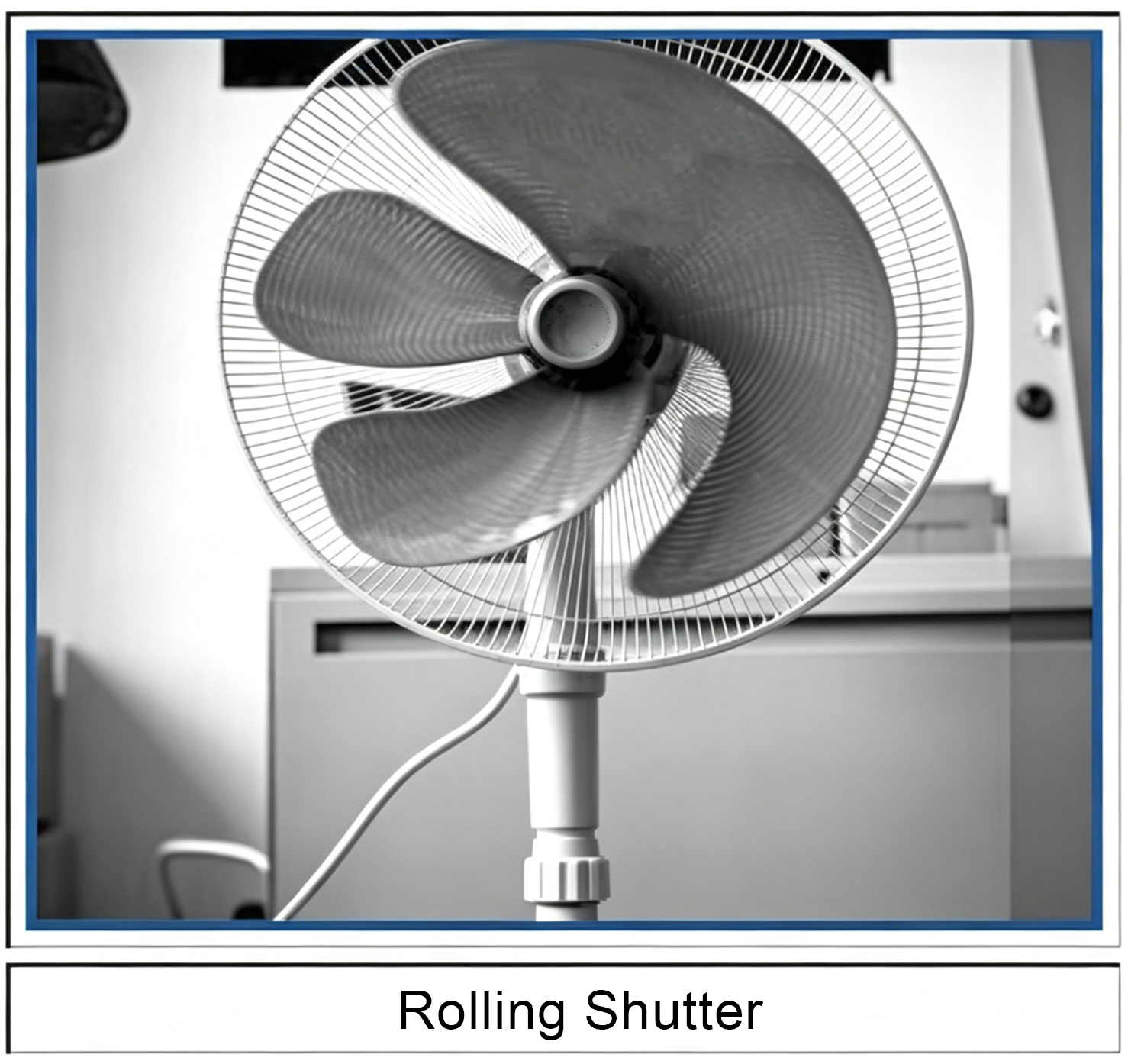
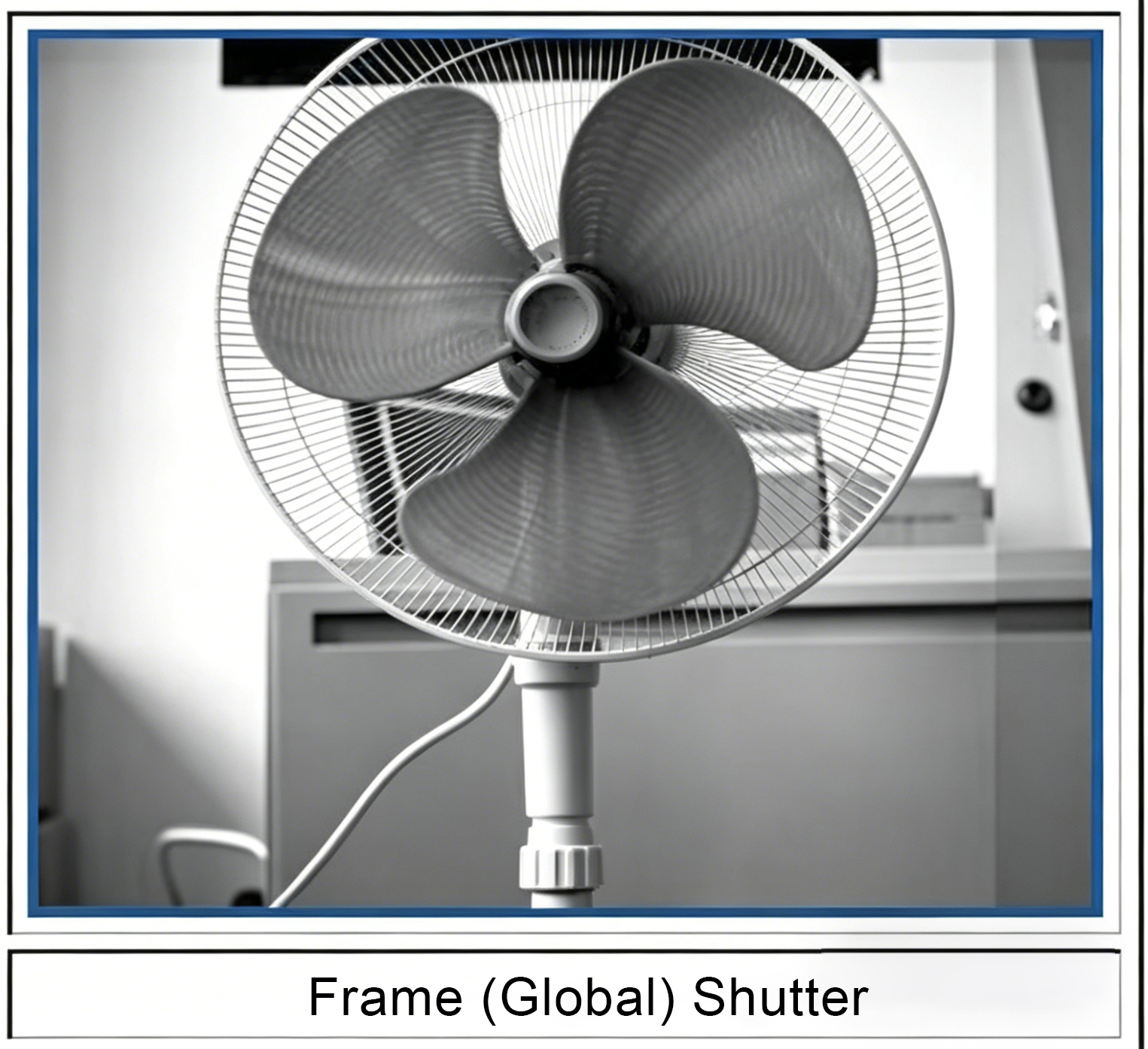
The shutter type determines how the image sensor captures an object. A rolling shutter exposes the sensor row by row, while a global shutter exposes the entire image at essentially the same time. This difference can directly affect image quality in industrial inspection, robotic vision, motion measurement, and high-speed production applications.
Therefore, the key question for engineers is not simply: “Is a global shutter always better than a rolling shutter?” Instead, the better question is: “Which shutter technology is more suitable for my specific application?”
1. What Is a Rolling Shutter Industrial Camera?
A rolling shutter camera does not expose the entire image simultaneously. Instead, different rows of pixels are exposed and read sequentially.
Because there is only a very small time difference between the exposure of different rows, this difference generally has little impact when imaging stationary or slowly moving objects.
Therefore, rolling shutter industrial cameras can be considered for applications such as:
- Static product inspection
- Document and surface imaging
- Microscopy
- Laboratory imaging
- Static dimensional inspection
- Inspection of slowly moving objects
- Cost-sensitive machine vision equipment
However, when the target moves quickly, the fact that different areas of the sensor are exposed at slightly different times can result in geometric image distortion.
Common rolling shutter artifacts include:
- Skewed objects
- Distorted straight edges
- Distortion of rotating objects
- Wobble or “jello” effects
- Position measurement errors
Rolling shutter technology is therefore not unsuitable for industrial vision. Instead, it should be evaluated according to the object speed, exposure time, and specific inspection requirements.
2. What Is a Global Shutter Industrial Camera?
A global shutter camera exposes the entire sensor at essentially the same moment, allowing the complete image to represent the state of the target at a specific point in time.
This characteristic makes global shutter particularly suitable for machine vision applications involving moving objects.
For example, imagine a product moving rapidly through a camera's field of view on a high-speed conveyor. With a rolling shutter, the top and bottom portions of the image may be captured at slightly different times, during which the product has already moved. A global shutter captures the entire frame at essentially the same time, helping preserve the geometric shape of the moving object.
Global shutter industrial cameras are therefore commonly used for:
- High-speed production inspection
- Robotic vision
- Pick-and-place applications
- Precision dimensional measurement
- Conveyor inspection
- Motion analysis
- Barcode and code reading
- Electronic component inspection
- Automotive component inspection
- Semiconductor inspection
- Pharmaceutical and packaging inspection
3. What Is the Difference Between Rolling Shutter and Global Shutter?
The fundamental difference is the way the image sensor exposes the image.
| Comparison Item | Rolling Shutter | Global Shutter |
|---|---|---|
| Exposure | Row by row | Entire frame |
| Stationary objects | Excellent | Excellent |
| Slow-moving objects | Suitable | Excellent |
| Fast-moving objects | Potential distortion | Recommended |
| Precision measurement | Application dependent | Recommended |
| High-speed inspection | Application dependent | Recommended |
| Cost optimization | Often advantageous | Usually higher |
| Motion distortion | Possible | Greatly reduced |
It is important to note that shutter type is not the only factor determining image quality.
The final imaging performance also depends on:
Exposure time + object speed + sensor readout + lighting + frame rate + optics + triggering
In particular, motion blur and rolling shutter distortion are two different problems. Reducing exposure time can reduce motion blur, but it does not necessarily eliminate geometric distortion caused by rolling shutter operation.
4. When Should You Choose a Rolling Shutter Camera?
Rolling shutter does not necessarily mean “low-end.” For the right applications, it can provide an excellent balance between image quality, resolution, and system cost.
4.1 The Target Is Stationary
If the inspection target remains stationary during image acquisition, the timing difference between sensor rows generally has little practical impact.
For example:
- Static product inspection
- Microscopy
- Laboratory equipment
- Fixed-position inspection
4.2 The Target Moves Slowly
If the target moves slowly and travels only a small distance during image acquisition, the impact of rolling shutter distortion may be minimal.
4.3 Cost Optimization Is Important
If the application does not technically require global shutter, a rolling shutter camera can help reduce the overall machine vision system cost. This can be particularly valuable for OEM manufacturers producing machine vision equipment in volume.
4.4 High Resolution Is a Priority
If an application prioritizes image detail and resolution rather than high-speed motion capture, a high-resolution rolling shutter camera can be a practical choice.
5. When Should You Choose a Global Shutter Camera?
When the target is moving significantly or rapidly, global shutter is generally the safer choice.
5.1 Fast-Moving Objects
For example:
- High-speed conveyor inspection
- Packaging inspection
- Product sorting
- Electronic component inspection
- Automotive component inspection
5.2 Precision Dimensional Measurement
If the camera is used to calculate:
- Length
- Width
- Diameter
- Angle
- Position
- Edge location
- Distance
- Component alignment
Then geometric accuracy becomes particularly important. For precision measurement systems, global shutter is generally the preferred choice.
5.3 Robotic Vision
When an industrial camera is mounted on a robot or moving platform, both the camera and the target may be moving. Global shutter can help the system capture more geometrically consistent images of moving targets.
It is therefore suitable for:
- Robotic picking
- Visual positioning
- Automated assembly
- Robotic guidance
6. How to Select the Right Shutter for Industrial Inspection
Engineers should not simply ask whether the object is moving. Several parameters should be evaluated together.
Step 1: Determine Object Speed
The first question should be: How fast is the inspection target moving? The faster the target moves, the stronger the case for choosing a global shutter camera.
Step 2: Determine Exposure Time
Exposure time directly affects motion blur. High-speed inspection may require:
- Short exposure
- High-intensity lighting
- Strobe lighting
- External triggering
- Global shutter
The camera and lighting system should therefore be designed together as one imaging system.
Step 3: Determine Whether Precision Measurement Is Required
If the system only needs to determine: “Is the product present?” A rolling shutter camera may be sufficient under suitable conditions.
If the system needs to determine: “What is the exact dimension of the product?” Or: “How much has the component shifted?” Then a global shutter camera is generally more suitable.
7. How to Select a MindVision Industrial Camera?
For industrial customers, camera selection often requires balancing:
Shutter type + resolution + frame rate + interface + transmission distance + triggering + lighting + software compatibility
MindVision provides industrial camera solutions for different performance levels and applications, including area scan cameras, line scan cameras, USB3.0 cameras, GigE cameras, 10GigE cameras, high-speed cameras, SWIR cameras, and other specialized imaging solutions.
This allows customers to select different shutter types, resolutions, and interfaces according to their application requirements while maintaining a consistent camera supplier.
8. MindVision Global Shutter Cameras for High-Speed Machine Vision
For high-speed moving targets and precision inspection applications, MindVision provides a range of global shutter industrial cameras.
For example, MindVision's GigE area scan camera portfolio provides different models for different resolution, frame rate, and sensor requirements.
MindVision's USB3.0 industrial camera portfolio also includes multiple global shutter models for high-speed inspection, positioning, measurement, and automation equipment integration.
These cameras are particularly suitable for:
- Automated inspection
- High-speed quality inspection
- Robotic vision
- Electronic component inspection
- Assembly inspection
- Barcode and OCR
- Positioning
9. MindVision Rolling Shutter Cameras: Balancing Imaging and Cost
For stationary or slowly moving targets, there is no need to add unnecessary system cost simply because global shutter is available.
MindVision also provides rolling shutter industrial cameras for static inspection, high-resolution imaging, and cost-sensitive OEM equipment.
For example, selected MindVision GigE products use rolling shutter sensors and can be selected according to different resolution and application requirements.
For OEM equipment manufacturers, this product portfolio provides flexibility to meet actual imaging requirements while maintaining better control over total equipment cost.
10. GigE or USB3.0? The Interface Also Matters
After determining the shutter type, the next step is to select the appropriate camera interface.
USB3.0 Industrial Cameras
USB3.0 is suitable for:
- Compact inspection equipment
- Laboratory systems
- OEM equipment
- Embedded vision systems
- Short-distance camera connections
- Vision systems requiring straightforward integration
MindVision USB3.0 industrial cameras support features such as external triggering, programmable I/O, and different data output options, with support for Windows, Linux, and ARM Linux environments.
GigE Industrial Cameras
GigE industrial cameras are particularly suitable for factory automation and production-line inspection.
One major advantage of GigE is its ability to support longer-distance transmission through Ethernet, making it suitable for:
- Factory automation
- Multi-camera systems
- Production-line inspection
- Long-distance camera installation
- Equipment integration
For large machine vision systems and distributed inspection equipment, GigE industrial cameras provide considerable system flexibility.
11. High-Speed Applications: When Do You Need a Higher-Performance Camera?
For certain high-speed production and motion inspection applications, standard USB3.0 or GigE cameras may not provide sufficient frame rates.
In these applications, engineers need to consider not only shutter type but also:
- Ultra-high frame rate
- High-bandwidth interfaces
- High-speed data transmission
- External triggering
- Lighting synchronization
For example, MindVision provides high-speed industrial camera solutions designed for imaging high-speed moving targets.
For these applications, global shutter + high frame rate + high-speed interface should often be considered as one complete imaging solution.
12. How Should You Select a Camera for Different Industrial Applications?
| Application | Recommended Shutter | MindVision Selection |
|---|---|---|
| Static inspection | Rolling / Global | USB3.0 / GigE |
| Slow-moving inspection | Rolling / Global | USB3.0 / GigE |
| Conveyor inspection | Global | GigE / 10GigE |
| High-speed inspection | Global | High-frame-rate GigE / 10GigE |
| Robotic vision | Global | USB3.0 / GigE |
| Precision measurement | Global | High-resolution Global Shutter |
| Moving-object OCR | Global | Global Shutter |
| Electronics inspection | Global | Global Shutter |
| Large-area inspection | Global | High-resolution / High-bandwidth |
| Web/material inspection | Global / Line Scan | Line Scan |
| Ultra-high-speed inspection | Global | High-speed / Fiber / CoaXPress |
| Static high-resolution imaging | Rolling | High-resolution Rolling Shutter |
| OEM vision equipment | Depends on motion | USB3.0 / GigE |
The table above should only be used as a starting point for industrial camera selection.
The final camera model should be selected according to target size, field of view, working distance, defect size, object speed, required resolution, frame rate, lighting conditions, triggering requirements, and processing platform.
13. Why Choose MindVision Industrial Cameras?
Industrial camera selection is about much more than choosing a sensor.
A complete machine vision system typically includes:
Industrial camera + lens + lighting + trigger + interface + SDK + vision software + industrial computer
If engineers focus only on camera specifications while ignoring the lens, lighting, and triggering system, even a high-resolution global shutter camera may not deliver the desired inspection performance.
MindVision offers a broad industrial imaging portfolio covering area scan, line scan, high-speed imaging, SWIR, and other specialized imaging solutions.
Different interfaces, including USB3.0, GigE, 10GigE, and high-speed fiber solutions, allow MindVision cameras to support applications ranging from compact OEM equipment to demanding high-speed industrial inspection systems.
For equipment manufacturers and system integrators, this provides greater flexibility when configuring cameras for different machine vision projects.
14. Rolling Shutter or Global Shutter? The Final Decision
There is no absolute answer as to which technology is universally better. The correct choice depends on the actual application.
Choose Rolling Shutter if:
- The target is stationary
- The target moves slowly
- High resolution is a priority
- Cost optimization is important
- Motion distortion is not a major concern
Choose Global Shutter if:
- The target moves quickly
- The camera or robot is moving
- Precision measurement is required
- Short exposure is required
- Strobe lighting is used
- Image synchronization is important
- High-speed automated inspection is required
In simple terms:
- Stationary target → Rolling shutter may be sufficient
- Fast-moving target → Global shutter is generally preferred
- Precision measurement → Global shutter is generally preferred
- Cost-sensitive static inspection → Rolling shutter can be considered
15. Need Help Choosing the Right Industrial Camera?
If you are still unsure whether your application requires a rolling shutter or global shutter camera, you can provide MindVision with the following information:
- Inspection object
- Target size
- Defect size
- Object speed
- Field of view
- Working distance
- Required resolution
- Required frame rate
- Lighting conditions
- Trigger requirements
- Transmission distance
- Interface preference
- Operating system
- Machine vision software
Based on these parameters, the appropriate solution can be selected from:
Global Shutter Camera / Rolling Shutter Camera / GigE Camera / USB3.0 Camera / High-Speed Camera / Line Scan Camera / SWIR Camera
For OEM/ODM projects, MindVision can also provide industrial camera solutions tailored to equipment structure, installation space, interface, performance, and application requirements.
If you are looking for industrial cameras for machine vision, automated inspection, robotic vision, quality inspection, or high-speed industrial applications, contact MindVision for camera selection support.
#MindVision
From standard USB3.0 and GigE industrial cameras to high-speed and specialized imaging solutions, MindVision provides flexible and reliable industrial imaging products for OEM manufacturers, system integrators, and industrial automation customers worldwide.
Choosing the right shutter is only the first step. Selecting the right camera for the entire vision system is the key to achieving stable and efficient industrial inspection.
Email: GlobalMarket@mindvision.com.cn
Website: https://www.mindvision.ltd/
We’ll be glad to help you
Please Login
Full Name
Company Name
E-mail*
Country / Region
Your Needs / Application*
Verification code

Get in touch
Name*
E-mail*
Country*
Your Needs / Application*
