
Embedded Machine Vision: The “Perceptual Foundation” of Intelligent Devices
Embedded Machine Vision:
The “Perceptual Foundation” of Intelligent Devices
Unlike traditional vision systems that rely on PCs or cloud servers, embedded vision emphasizes low latency, low power consumption, high reliability and edge intelligence – making it the core technological pillar for autonomous perception in robotics, drones, intelligent surveillance, industrial inspection and edge AI devices.
As AI computing power shifts to the edge, embedded vision is evolving from a passive “capture+transmit” model to an active “capture+process+decide” intelligent paradigm. This transformation places new demands on vision hardware: beyond excellent image quality, it must achieve seamless collaboration with edge computing platforms (such as Jetson, RK3588, Raspberry Pi, etc.) under multiple constraints including form factor, power consumption, interface compatibility, and environmental robustness.
Against this backdrop, stereo vision modules and ultra-thin board-level cameras have become the two most core and edge-optimized hardware forms in embedded vision. Stereo modules endow machines with depth perception – ideal for SLAM navigation, obstacle avoidance, and 3D metrology; board-level cameras, with their extreme miniaturization and low power consumption, provide a highly integrated vision interface for space-constrained mobile devices.
MindVision, as a leading domestic industrial camera manufacturer, has been dedicated to the R&D, production, and manufacturing of industrial cameras since its establishment in 2013. It has become a top player in the domestic industrial camera industry, with production centers and R&D bases in Shenzhen, Changsha, and Wuxi, employing nearly 300 people. Its product portfolio covers area-scan cameras, line-scan cameras, thermal cameras, smart cameras, 3D cameras, stereo camera modules, customized complete cameras, and camera modules, with over 100 patents and software copyrights. In the embedded vision field, MindVision's stereo modules and board-level cameras, leveraging high integration, flexible customization, and cross-platform compatibility, have been widely adopted in scientific research, intelligent transportation, biomedicine, non-standard automation, electronics manufacturing, photovoltaic inspection, semiconductor, public security, and model aviation.
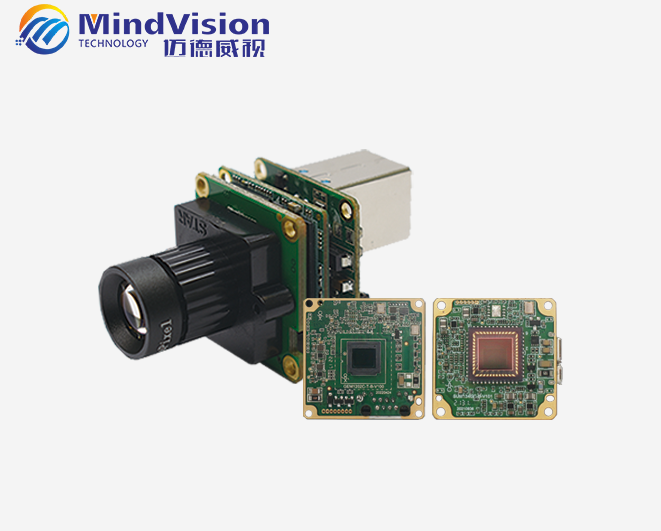
I. Stereo Modules – Endowing Machines with Stereoscopic Vision
Stereo vision mimics the human visual system by capturing the same scene from two different viewpoints and computing depth from disparity. MindVision's stereo camera modules are purpose-built for stereoscopic vision and depth sensing, available in both USB3.0 and GigE interface series.
Key Advantages
- Microsecond-level hardware synchronization: Supports continuous, software-trigger, and hardware-trigger operating modes; both left and right images are automatically synchronized with synchronization error in the microsecond range. This ensures strict left-right alignment, delivering clear depth maps even in fast-motion scenes, avoiding ghosting and depth-calculation errors caused by sync drift.
- Flexible customization: Sensor board size can be customized per customer requirements; FPC cable length is replaceable; baseline is adjustable. For close range (<2m), a 5-10cm baseline is recommended; for long range (5-10m), 20-30cm is suggested. MindVision supports on-demand customization.
- Lossless RAW output: Supports 8-bit, 12-bit and 16-bit lossless grayscale output, preserving complete image data for AI algorithms. Unlike UVC-based stereo modules on the market, MindVision employs a dedicated SDK that supports higher pixel counts with no theoretical upper resolution limit – better suited for mid-to-high-end 3D applications.
- Rich interfaces and expansion: Modules reserve 2 RS232 ports, 1 GPIO, 1 strobe output, and 1 hardware trigger input, all customizable. The on-board RS232 can be used to control other components, simplifying system design and reducing cost.
- Cross-platform compatibility: Provides dedicated SDK and drivers supporting Windows, Linux, ARM Linux, and macOS, fully compatible with MindVision's single-camera SDK. Supports development languages including C/C++/C#/VB6/VB.NET/Delphi/Java/Labview, with abundant demos; compatible with vision software such as Halcon, VisionPro, and OpenCV.
Representative Models
| Model | Interface | Resolution | Max FPS | Pixel Size | Typical Application |
|---|---|---|---|---|---|
| MV-MSU133GC/M2-T | USB3.0 | 1280×1024 | 130fps | 4.0μm | High-speed SLAM, drone obstacle avoidance |
| MV-MSU134GC/M2-T | USB3.0 | 1280×1024 | 123fps | 4.8μm | Low-light stereo vision |
| MV-MGE131GC2-T | GigE | 1280×960 | 42fps | 3.75μm | Long-range industrial 3D metrology |
II. Board-Level Cameras – The “Ultimate Form” of Embedded Integration
Board-level cameras feature a single-board, enclosure-free design, optimized for embedded integration. MindVision's GigE and USB3.0 board-level camera modules provide cost-effective vision solutions for devices with tight space and power budgets.
Key Advantages
- Extremely slim and lightweight: Single-board design with compact, ultra-thin dimensions. For example, the MV-GEM133GC/M-T-F measures only 20×18mm in cross-section (excluding lens mount) and weighs less than 100g. The M12 lens mount further reduces overall thickness.
- Ultra-low power consumption: Typical power <2.5W, suitable for battery-powered mobile devices and drone payloads.
- Lossless image output: Supports 16-bit grayscale and 48-bit color lossless formats, preserving complete image data for subsequent AI processing.
- Flexible lens mount: Offers board-only, C-mount, and M12 mount options. C-mount provides a wider lens selection; M12 mount is thinner and lighter, ideal for weight-sensitive applications like drones.
- Cross-platform driver support: Supports PC Linux and ARM Linux systems for seamless integration into embedded devices. Compliant with GigE Vision V1.2 and GenICam standards, with driver-free support for Halcon, VisionPro, and other vision software.
- Hardware acceleration: Built-in hardware image processing acceleration reduces host CPU load; supports arbitrary-size ROI, custom resolution, contrast and gamma adjustment, white-balance correction, black-level correction, ISP acceleration, 3D noise reduction, and custom LUT tables.
Representative Models
| Model | Interface | Resolution | FPS | Feature | Application |
|---|---|---|---|---|---|
| MV-SUM133GC/M | USB3.0 | 1280×1024 | 221fps | Ultra-high frame rate | High-speed motion capture, drones |
| MV-GEM133GC/M-T-F | GigE | 1280×1024 | 91fps | BSI, excellent low-light | Surveillance, night monitoring |
| MV-GEM134GC/M | GigE | 1280×1024 | 91.5fps | General-purpose global shutter | Industrial inspection, robotics |
| MV-GEM1201C/M | GigE | 4000×3000 | 9.75fps | 12MP high detail | High-res metrology, OCR |
| MV-GEM2000C-T1-CH20 | GigE | 5480×3648 | 6fps | 20MP | Precision defect inspection |
III. Typical Application Scenarios
Scenario 1: Autonomous Mobile Robot SLAM Navigation and Obstacle Avoidance
Task Description: AGVs/AMRs or service robots use visual odometry (VIO) and SLAM for autonomous localization and navigation. They must capture environmental features in real time, compute poses quickly, and identify obstacles for collision avoidance.
Why choose a stereo module: Stereo modules naturally provide disparity-based depth information, delivering dense depth maps without additional structured light or LiDAR. MindVision's microsecond-level synchronization ensures strict left-right alignment, giving VIO/SLAM algorithms high-accuracy depth data. The 130fps high frame rate handles rapid rotation and movement, while the global shutter eliminates motion distortion, making feature-point extraction more reliable during fast motion.
Typical Configuration: MV-MSU133GC/M2-T stereo module + NVIDIA Jetson Orin / RK3588 edge computing platform. The reserved GPIO and trigger inputs synchronize fill-lights or encoders. The product has been successfully deployed in ROS-based robot navigation systems and visual SLAM projects.
Value: No external depth sensor needed – a single stereo module simultaneously handles localization, mapping and obstacle avoidance, significantly reducing system cost and power consumption.
Scenario 2: Industrial 3D Metrology and Defect Inspection
Task Description: On production lines, perform 3D dimensional measurement, surface defect detection, or assembly verification on workpieces – requiring high precision, high repeatability, and fast response.
Why choose a stereo module or high-resolution board-level camera: For 3D profiling, a stereo module (or stereo structured-light module) captures workpiece point-cloud data in a single shot via disparity. MindVision's stereo products support lossless RAW output, preserving full image data for high-precision 3D reconstruction. Typical applications include body-feature positioning in automotive welding shops, achieving 0.1mm/1m accuracy. For 2D surface defect inspection, high-resolution board-level cameras like the MV-GEM1201C/M (12MP) or MV-GEM2000C-T1-CH20 (20MP) capture fine defects. The ultra-thin board-level design fits easily into narrow inspection stations.
Typical Configuration: MV-MGE131GC2-T stereo module (GigE, supporting 100m long-distance transmission) + industrial lighting + edge AI box. The camera features programmable I/O and supports external trigger for synchronized strobe illumination.
Value: One stereo system replaces the traditional “2D camera + laser rangefinder” combination, acquiring both complete 2D images and 3D point clouds in a single shot – greatly improving inspection efficiency.
Scenario 3: Drone and Mobile Device Vision Payload
Task Description: Drones or handheld devices are extremely sensitive to weight, power, and size – requiring ultra-thin, lightweight, low-power vision modules with vibration resistance and wide-temperature operation.
Why choose board-level cameras: Board-level cameras feature an enclosure-free single-board design with thickness <20mm (excluding lens mount), weight <100g, and power <2.5W – all critical for drone endurance and flight performance. The M12 lens mount further reduces overall size. The wide-temperature operating range (0~50°C operation, -30~60°C storage) suits outdoor environments. ARM Linux driver support enables direct adaptation to mainstream drone computing platforms like Jetson and RK3588.
Typical Configuration: MV-SUM133GC/M board-level camera (USB3.0, 221fps ultra-high frame rate) + flight controller + onboard AI module. For obstacle-avoidance drones, a lightweight stereo module can be added for visual positioning and obstacle perception.
Value: Every gram saved and every 0.1W reduced in camera weight/power directly translates to longer flight endurance and greater payload margin. Board-level cameras make “fingertip-sized” drone vision a reality.
Scenario 4: Intelligent Surveillance and Edge AI Behavior Recognition
Task Description: Perform real-time detection and recognition of people, vehicles, or abnormal behaviors at the edge – requiring stable imaging under low light and wide dynamic range, plus on-device AI inference.
Why choose a board-level low-light camera: The MV-GEM133GC/M-T-F features a backside-illuminated (BSI) sensor with 4μm pixel size and low-light sensitivity up to 8V/Lux·s, delivering clear images even in dim conditions. Its board-level design fits directly inside bullet or dome housings, saving enclosure space. ARM Linux driver support eases integration with NPU chips for local AI inference. GigE supports 100m long-distance transmission, suitable for wide-area surveillance deployments. For 3D behavior analysis (e.g., intrusion detection, loitering recognition), a stereo module can provide depth maps as auxiliary input.
Typical Configuration: MV-GEM133GC/M-T-F board-level camera (GigE) + Rockchip RK3588 edge AI box. The camera supports unlimited simultaneous multi-camera operation, enabling centralized edge processing for multi-channel surveillance.
Value: AI inference at the edge – only alerts and key frames are uploaded, drastically reducing network bandwidth and cloud storage costs while meeting data privacy compliance requirements.
Scenario 5: Smart Retail and Interactive Displays
Task Description: People counting, shelf recognition, gesture interaction, or AR/VR applications require wide-angle, color-accurate, high-frame-rate imagery under varying indoor lighting conditions.
Why choose a board-level USB3.0 camera: USB3.0 is plug-and-play with UVC protocol support for driver-free development, greatly shortening prototyping cycles. The board-level design enables hidden installation without compromising retail aesthetics. HDR mode and auto white-balance handle varying indoor lighting. For gesture recognition or people-trajectory tracking, a stereo board-level module provides both RGB and depth simultaneously, improving interaction robustness. MindVision SDK supports mainstream AI frameworks like TensorRT and OpenCV for rapid deep-learning deployment.
Typical Configuration: MV-SUM133GC/M board-level camera (USB3.0, 221fps) + Raspberry Pi 4B/CM4. Developers have already used MindVision cameras + Raspberry Pi to build vision-based counting systems.
Value: Low cost, rapid deployment, high reliability – an affordable smart vision solution for every retail store.
IV. Frequently Asked Questions (FAQ)
It depends on whether your application requires depth information. A stereo module outputs depth maps directly via disparity, making it suitable for SLAM navigation, obstacle avoidance, and 3D metrology – with microsecond-level hardware synchronization ensuring strict left-right alignment. A board-level camera is more suitable for 2D recognition, inspection, and surveillance where depth is not required; its ultra-slim and low-power design suits drones, handheld devices, and other space-constrained mobile platforms.
Sync errors cause position mismatch of moving objects between left and right images, producing ghosting and deviation in depth maps. If sync error exceeds 1ms, positional deviation in left/right images will cause triangulation errors, with depth errors amplifying exponentially. MindVision's stereo modules employ hardware-level synchronization with error <5μs (microsecond level) – meaning even at 10m/s object motion, positional deviation is <0.05mm at 1m distance, delivering virtually ghost-free depth maps suitable for demanding scenarios like high-speed SLAM and drone obstacle avoidance.
The longer the baseline, the higher the far-field ranging accuracy, but the near-field blind zone and physical size also increase. General guideline: for close range (<2m), use 5-10cm baseline; medium range (2-5m): 10-20cm; long range (5-10m): 20-30cm. MindVision supports factory-preset baseline customization. The baseline is fixed by hardware and cannot be adjusted after delivery.
Global shutter exposes all pixels simultaneously, perfectly capturing fast-moving objects and eliminating the “jello effect”. Rolling shutter exposes line by line, causing distortion when capturing fast-moving objects. For motion scenarios like robotics, drones, and conveyor inspection, global shutter is mandatory. Rolling shutter is only suitable for static or very slow scenes, but offers higher quantum efficiency and better low-light performance. Most MindVision stereo and board-level cameras offer global shutter models.
Each interface has its own strengths – USB3.0 (5Gbps, <5m) is plug-and-play and easy to develop with, suitable for dev boards, drones, and rapid prototyping; GigE (1Gbps, 100m) supports long-distance transmission with strong anti-interference, suitable for industrial inspection and surveillance; MIPI CSI (1.5-4Gbps/lane, <30cm) connects directly to SoC with the lowest power, suitable for smartphones and deeply customized embedded products. For embedded systems, USB3.0 is recommended for development convenience, while MIPI offers the best power/latency performance. MindVision stereo modules primarily use USB3.0, while board-level cameras cover all three interfaces.
Resolution selection depends on field of view, required precision, frame rate needs, and compute constraints. General rule: the target object should occupy at least 50-100 pixels in width for reliable AI detection. For stereo SLAM and obstacle avoidance, 1-2MP is sufficient for most needs (algorithms typically downsample). For inspection requiring small character or fine defect recognition, 5MP or higher is recommended. Higher resolution reduces maximum frame rate and increases embedded processing load – a trade-off between detail and speed.
For heat dissipation, most board-level cameras draw <2.5W and can rely on natural convection. For sustained high-frame-rate operation in sealed spaces or high-temperature environments (>50°C), consider choosing a low-power model, monitoring temperature via GPIO for dynamic frame-rate reduction, adding a heatsink, or using metal housing heat conduction. For waterproofing, board-level cameras are not inherently protected – a custom enclosure is required. MindVision provides mechanical design advice and can work with third-party waterproof housings to achieve IP67 or higher. Special attention must be paid to sealing the FPC cable interface and lens mount during integration.
Yes. MindVision board-level cameras provide ARM Linux drivers supporting Ubuntu, L4T (Jetson), Rockchip SDK, etc. USB3.0 models are plug-and-play. Raspberry Pi 4B/CM4 can use them directly via USB3.0; for MIPI CSI, additional driver adaptation is required (technical support available). MindVision provides pre-compiled libraries and OpenCV C++/Python examples across all board-level cameras, greatly reducing porting effort. Developers have already used MindVision cameras + Raspberry Pi to build vision-based counting systems.
V. Conclusion
From the “eyes” of robots to the “eagle eyes” of drones, from the “discerning eyes” of industrial inspection to the “perceptive windows” of smart retail – embedded machine vision is redefining how intelligent devices perceive the world. MindVision's stereo modules and board-level cameras, with their core advantages of microsecond-level synchronization, extreme slimness, ultra-low power, and cross-platform compatibility, provide a solid and reliable hardware foundation for all types of embedded vision applications.
Whether it's SLAM navigation requiring depth perception, drone payloads pursuing extreme lightweight, or intelligent surveillance emphasizing low-light performance – MindVision delivers complete solutions from hardware to drivers, allowing developers to focus on algorithmic and application innovation.
#MindVision
MindVision Technology Co., Ltd. is a professional domestic industrial camera manufacturer headquartered in Shenzhen, with production centers and R&D bases in Changsha (Hunan) and Wuxi (Jiangsu), employing nearly 300 people. Its product portfolio covers seven major categories including area-scan cameras, line-scan cameras, thermal imaging cameras, smart cameras, 3D cameras, and stereo camera modules, with over 100 patents and software copyrights. The company is ISO9001 certified.
For more information or free selection consulting, please visit MindVision's official website or contact the sales team.
We’ll be glad to help you
Please Login
Full Name
Company Name
E-mail*
Country / Region
Your Needs / Application*
Verification code

Get in touch
Name*
E-mail*
Country*
Your Needs / Application*
