
Hawk-Eye Officiating, Live Streaming & Highlight Videos: A Camera Selection Guide for Sports Venues
Recommended: the MindVision MV-XGC507GC 5MP Color 10GigE Industrial Camera
Hawk-Eye Officiating, Live Streaming & Highlight Videos: A Camera Selection Guide for Sports Venues
Table of Contents
- Three Services Every Modern Venue Wants: Hawk-Eye, Live & Highlights
- Three Services, One Capture Chain: What Cameras Must Deliver
- Recommended: The MV-XGC507GC 5MP Color 10GigE Industrial Camera
- Service by Service: What Each Application Draws from the Camera
- Court Installation and Lens Selection
- Software Platforms and System Integration
- Pre-Purchase Verification Checklist
- Frequently Asked Questions (FAQ)
- Contact MindVision
1. Three Services Every Modern Venue Wants: Hawk-Eye, Live & Highlights
Sports venues and event operators today offer far more than a court. More and more venues want to layer three vision-based services into their operations:
- Hawk-eye officiating — ball-trajectory tracking and landing-spot judgment to resolve officiating disputes, raising the professionalism and credibility of the event;
- Live streaming — pushing match footage continuously and reliably to online channels, extending the event's reach;
- Highlight videos — turning key rallies into slow-motion replays and compilations, building a content asset that keeps working after the match ends.
The three services look different, but they start from the same place: front-end image capture. Cameras are mounted behind both baselines of the court (typically 6–8 m behind the baseline, about 4 m high, fixed overhead). Every millimeter of officiating accuracy, every frame of stream quality, and every replay clip rests on the raw images those cameras deliver.
For venues and event operators, camera selection is the foundation of this investment: choosing the wrong camera costs more than repurchasing it — it means re-installation, re-development, and possibly a missed season. This guide starts from what the three services actually demand, distills the selection criteria, and recommends one industrial camera that can serve all three directions: the MindVision MV-XGC507GC.
2. Three Services, One Capture Chain: What Cameras Must Deliver
However the services are combined, the demands on the camera fall into five buckets:
| Capability | Why It Matters |
|---|---|
| Resolution | Cover the full court while preserving usable image detail of the ball and court lines — the image foundation of landing-spot judgment |
| Frame rate & exposure | Continuous imaging with low motion blur — a tennis ball moves extremely fast; frame interval and exposure time directly decide whether the ball is sharp or smeared |
| Trigger & synchronization | Multiple cameras capture from different angles; time-consistent exposure moments are the prerequisite for cross-view image matching and trajectory reconstruction |
| Data transmission | Continuous high-resolution capture is data-intensive; the link needs enough bandwidth or congestion and frame loss follow |
| Software compatibility | Easy integration with Linux-based vision computing platforms, shortening the path from camera to working service |
3. Recommended: The MV-XGC507GC 5MP Color 10GigE Industrial Camera
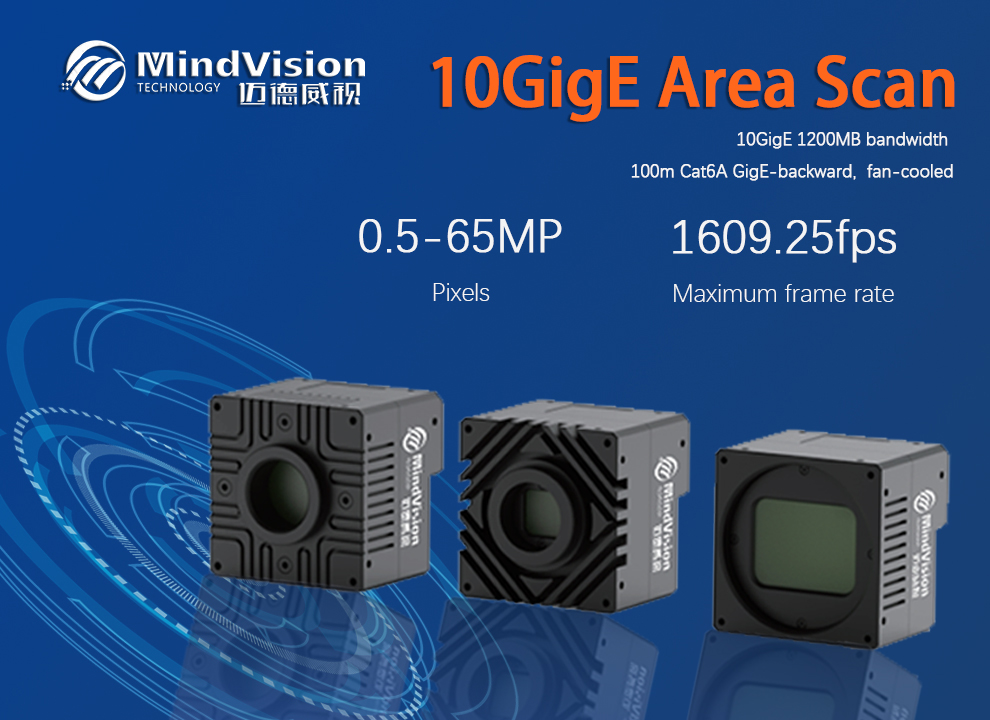
For high-speed vision applications like hawk-eye, live streaming, and highlights, the MindVision MV-XGC507GC is a strong candidate core capture device for sports vision systems, providing the hardware basis for project development and solution validation. The series offers color (GC) and monochrome (GM) models; the MV-XGC507GC is the color model — better suited to applications that need to preserve court color information, run color image analysis, or double for broadcast footage.
| Specification | MV-XGC507GC |
|---|---|
| Camera type | Color industrial camera |
| Sensor | 2/3-inch CMOS (GMAX3405) |
| Effective pixels | 5 megapixels |
| Maximum resolution | 2448 × 2048 |
| Nominal max frame rate | 236.25 fps (at 2448 × 2048) |
| Pixel size | 3.4 μm × 3.4 μm |
| Output pixel depth | 12 bit |
| Lens mount | C-mount |
| Data interface | 10GBase-T |
| Trigger features | GPIO; trigger and strobe-synchronization modes supported |
| Power / consumption | 24 V (±10%) / under 8 W |
| Operating temperature | 0–50 °C |
| Software platforms | Windows, Linux 32/64-bit |
What the three headline specs mean for selection
① 5 MP + 2/3" format: the balance between full-court coverage and detail. With fixed mounting, the system can evaluate imaging of the ball, court lines, and other key regions based on lens focal length, field of view, and required court coverage. The 2/3-inch CMOS with 3.4 μm pixels gives system designers an unambiguous sensor spec to work from.
② 236.25 fps nominal frame rate: generous capture headroom for high-speed motion. For systems that continuously record ball motion, this frame-rate capability provides room to design the capture strategy — hawk-eye converts high frame rate into trajectory density; highlight production converts it into slow-motion material.
③ 10GBase-T interface: the data channel for high-resolution imaging. Effective bandwidth of 1200 MB/s under 10GigE conditions, transmission up to 100 m, and backward compatibility with 100 M, 1 G, 2.5 G, and 5 G links. For multi-camera systems, 10 Gigabit Ethernet relieves link pressure during continuous high-resolution capture and leaves bandwidth headroom for processing and expansion.
Note: whether the system can ultimately identify a high-speed ball accurately still depends on actual shooting distance, ball image size, lighting conditions, and algorithm performance — all subject to testing.
4. Service by Service: What Each Application Draws from the Camera
When one capture system serves three services, it helps to see clearly which capability each service "consumes" before making configuration decisions:
Service 1 · Hawk-Eye Officiating — Draws on resolution, frame rate, and multi-camera sync
Hawk-eye needs multiple cameras continuously capturing the court from different angles, feeding image recognition, trajectory reconstruction, and spatial localization. Disputes often come down to "the ball clipped the line by a few millimeters" — resolution sets the floor for detail, frame rate and exposure set motion sharpness, and multi-camera sync sets the time consistency that makes cross-view trajectory stitching possible. The MV-XGC507GC's GPIO provides two inputs, two outputs, and one configurable input/output, with trigger and strobe-synchronization modes — an interface basis for multi-camera design. Specific synchronization accuracy requirements are covered in the Section 7 checklist.
Service 2 · Live Streaming — Draws on color imaging and sustained transmission
Broadcast footage needs faithful court color and atmosphere — one reason to choose the color GC model. Live streaming prizes sustained stability over peak performance: the camera must hold steady output through long runs and varying light. The 10GigE link (1200 MB/s effective bandwidth) provides the channel for continuously moving high-resolution frames into the streaming pipeline. If one camera carries both hawk-eye capture and streaming, assess image-processing load, data bandwidth, and system latency up front so neither task degrades the other — deployments also exist where two cameras split the duties (one dedicated to hawk-eye, one covering capture plus streaming).
Service 3 · Highlight Videos — Draws on high frame rate and image quality
The value of highlight content lies in slow motion: 60 fps footage visibly stutters when slowed 4×, while high-frame-rate material plays back smoothly, revealing the moment of contact, ball deformation, and other fine detail. The 236.25 fps frame-rate headroom plus 12-bit output gives post-production higher-quality raw material. Continuous high-frame-rate capture is also data-intensive — storage and write throughput need early planning (see Section 7).
5. Court Installation and Lens Selection
Imaging quality depends not only on the sensor but also on the lens, mounting position, and environment. The MV-XGC507GC uses a standard C-mount, so industrial lenses can be selected per project.
Lens selection guidance (full-court overhead view)
- Field of view: horizontal FOV above 80°, preferably 85° or wider, to cover the full court;
- Distortion control: a well-corrected lens reduces geometric distortion at the court edges — important for spatial localization in landing-spot judgment;
- Aperture: a larger aperture design adapts to both daylight and floodlit courts;
- Locking mechanism: a locked lens reduces the risk of focus drift over long-term operation.
The specific lens must be calculated from the sensor format, mounting height (typically ~4 m), distance behind the baseline (typically 6–8 m), and required court coverage; the actual FOV and distortion of a wide-angle lens should be verified through real imaging.
Outdoor installation protection points
- When the project requires IP66 or higher, verify the protection level of the complete assembly — not the housing's rating alone;
- MV-XGC507GC operating temperature is 0–50 °C with consumption under 8 W — but deployment must still account for temperature rise inside the housing, direct sunlight, and local ambient temperature;
- Outdoor courts need a protection plan for cabling and power distribution as well.
6. Software Platforms and System Integration
Sports vision systems typically consolidate image capture, ball detection, trajectory computation, data logging, and live streaming into one software architecture — and the camera's SDK and interface compatibility directly affect delivery time.
- Standards: the MV-XGC507GC supports GigE Vision and GenICam and uses the same SDK as MindVision's Gigabit Ethernet cameras — reducing migration cost for existing vision projects;
- Platform support: the datasheet lists Linux 32/64-bit support plus language packages for C/C++, C#, Python, and Java, making it easy to interface with different event-system tech stacks;
- Embedded platforms: for projects using NVIDIA Jetson or similar embedded compute, confirm the specific Jetson model, OS version, driver dependencies, and SDK compatibility, then run sustained-capture tests on the target hardware;
- Bandwidth budgeting: in multi-camera deployments, budget bandwidth from pixel depth, target frame rate, packet overhead, NIC performance, and host processing capability to avoid network congestion or buffer backlog.
7. Pre-Purchase Verification Checklist
These items directly determine whether the project can meet its targets — lock them down item by item in contracts and technical agreements:
- ☐ Multi-camera sync accuracy: with multiple cameras receiving the same trigger signal, does the actual exposure skew meet the project requirement (typically ≤0.2 ms / 200 μs)? — to be tested under the actual target frame rate, exposure time, and wiring. Hardware-trigger support ≠ meeting a sync-accuracy requirement;
- ☐ PTP and timed trigger: IEEE 1588 PTP and timed-trigger support — note that PTP, timed trigger, and actual exposure synchronization are separate technical matters, each requiring its own confirmation;
- ☐ Frame numbers & timestamps: per-frame frame numbers and exposure timestamp output (a key basis for cross-view image matching);
- ☐ Trigger modes: support for the specific external hardware-trigger mode the project needs;
- ☐ Shutter type: the model's specific global-shutter attributes need item-by-item verification (a core parameter for high-speed motion capture);
- ☐ Embedded platform compatibility: specific Jetson model + OS version + driver dependencies + sustained-capture test;
- ☐ Assembly-level protection: measured IP rating of the complete housing + camera + cabling assembly;
- ☐ Storage plan: data volume and write throughput for continuous high-frame-rate capture;
- ☐ Prototype validation: final selection should rest on complete spec confirmation, prototype testing, and joint system verification.
8. Frequently Asked Questions (FAQ)
The MV-XGC507GC is a 5-megapixel color 10GigE industrial camera: 2/3-inch CMOS sensor (GMAX3405), maximum resolution 2448 × 2048, nominal maximum frame rate of 236.25 fps at that resolution, 3.4 μm pixels, 12-bit output, C-mount lens interface, 10GBase-T interface (1200 MB/s effective bandwidth, up to 100 m), GPIO supporting trigger and strobe-synchronization modes, 24 V ±10% power supply, under 8 W consumption, 0–50 °C operating temperature, and Windows plus Linux 32/64-bit software support.
A hawk-eye system needs multiple cameras continuously capturing the court from different angles. Core requirements: (1) resolution sufficient to preserve usable detail of the ball and court lines while covering the full court; (2) adequate frame rate and exposure control to reduce motion blur; (3) multi-camera triggering and synchronization for time-consistent cross-view image matching and trajectory reconstruction; (4) high-bandwidth data transmission for continuous capture; (5) software compatibility with Linux-based vision platforms. The camera is the capture front-end — officiating accuracy also depends on algorithms and the overall system.
Deployments vary: some use two cameras with a split of duties (one dedicated to hawk-eye analysis, one covering both hawk-eye capture and live streaming), others use multi-camera coordination. If a single camera carries both tasks, image-processing load, data-transfer bandwidth, and system latency should be assessed in advance to confirm the tasks do not interfere. The MV-XGC507GC's 10GBase-T interface (1200 MB/s effective bandwidth) provides the channel foundation, but actual feasibility depends on target frame rate and host processing capability.
Not from the datasheet alone. The MV-XGC507GC provides GPIO (two inputs, two outputs, and one configurable input/output) and supports trigger and strobe-synchronization modes, giving a functional basis for multi-device coordination. But a multi-camera exposure-skew requirement such as 0.2 ms (200 μs) must be tested under the actual target frame rate, exposure time, and wiring configuration. Hardware-trigger support does not equal meeting a synchronization-accuracy requirement; PTP (IEEE 1588), timed trigger, and actual exposure synchronization are separate technical matters that each need confirmation and testing.
Lens: with the C-mount interface, industrial lenses can be selected per project; for full-court overhead coverage, evaluate wide-angle lenses with a horizontal field of view above 80° (85° or more preferred), good distortion control, a large aperture, and a locking mechanism. Protection: when the project requires IP66 or higher, verify the protection level of the complete assembly (housing + camera + cabling), not the housing rating alone; also account for temperature rise inside the housing, direct sunlight, and local ambient temperature (camera operating range 0–50 °C, consumption under 8 W). Lens selection should be calculated from sensor size, mounting height (typically ~4 m), distance behind the baseline (typically 6–8 m), and required court coverage.
The MV-XGC507GC supports the GigE Vision and GenICam standards and uses the same SDK as MindVision's Gigabit Ethernet cameras, which helps reduce development migration cost for existing vision projects. The datasheet lists Linux 32/64-bit operating system support plus language packages for C/C++, C#, Python, and Java. For embedded platforms such as NVIDIA Jetson, confirm the specific Jetson model, OS version, driver dependencies, and SDK compatibility, then run sustained-capture tests on the target hardware.
9. Contact MindVision
Want to confirm whether the MV-XGC507GC configuration matches your sports venue application, or discuss a complete Hawk-Eye, live streaming, and highlight video solution? Reach out with your court dimensions, mounting constraints, synchronization requirements, and software platform — our engineering team will help evaluate selection, lens options, and system integration.
#MindVision
MindVision Technology Co., Ltd. is a professional domestic industrial camera manufacturer headquartered in Shenzhen, with production centers and R&D bases in Changsha (Hunan) and Wuxi (Jiangsu), employing nearly 300 people. Its product portfolio covers area-scan cameras, line-scan cameras, high-speed cameras, thermal imaging cameras, and stereo camera modules, with over 100 patents and software copyrights. The company is ISO9001 certified.
For more information or free selection consulting, please visit MindVision's official website or contact the sales team.
We’ll be glad to help you
Please Login
Full Name
Company Name
E-mail*
Country / Region
Your Needs / Application*
Verification code

Get in touch
Name*
E-mail*
Country*
Your Needs / Application*
